
A $9.25 monthly phone discount sits unclaimed by roughly four out of every five households that qualify for it. The federal Lifeline program covers phone or internet service for low-income Americans, and SNAP enrollment is one of the fastest paths to approval.
But the application itself trips up more people than the eligibility rules do. Missed documents, confusing provider lists, and a yearly recertification step that nobody warns you about cause thousands of approved recipients to lose service every year.
This guide is for SNAP recipients who want a free government phone and need a clear, no-nonsense walkthrough of how the program works in 2026, which providers are worth looking at, and what to do after approval so the benefit doesn't quietly disappear.
Does SNAP Automatically Qualify for a Free Government Phone?
Active SNAP enrollment is one of the most direct qualifiers for the Lifeline program. No income math required. If your household gets food stamps, you can skip the income verification step entirely and apply using your SNAP participation as proof.
The program also accepts Medicaid, Supplemental Security Income (SSI), Federal Public Housing Assistance, and Veterans Pension.
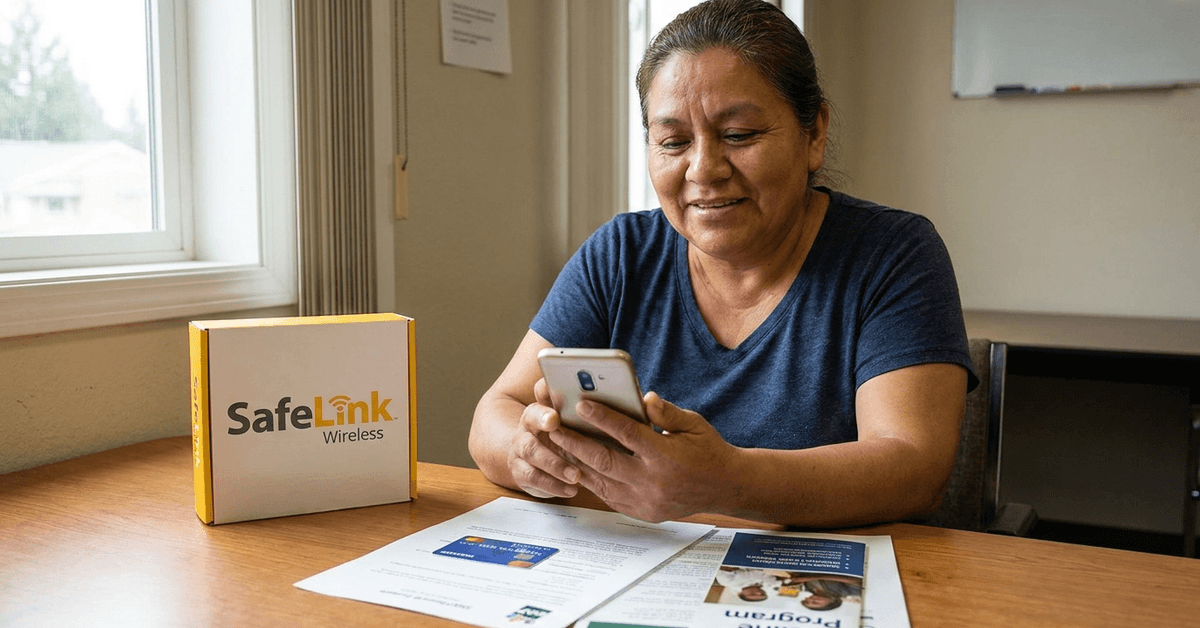
But for SNAP recipients specifically, the documentation is about as simple as it gets: a current EBT card or a benefit approval letter with a recent date.
The Income Path (If SNAP Lapses)
Should your SNAP benefits stop for any reason, there's still a backup route. Households earning at or below 135% of the Federal Poverty Guidelines can qualify based on income alone.
For a single person in 2026, that threshold sits around $20,783 per year. Larger households have higher limits that scale with family size.
The catch on the income side: you'll need documentation. A recent federal tax return (Form 1040) or three consecutive months of pay stubs will work.
It takes longer than the SNAP route because the National Verifier at lifelinesupport.org has to manually check income documents when it can't pull automatic program data.
One Benefit Per Household, Period
This rule catches people off guard. Lifeline allows one discount per household, not per person.
Two adults living at the same address who share expenses count as one household. A parent and adult child under one roof cannot both receive a Lifeline phone, even if both are on SNAP.
I think this one-per-household rule makes the provider choice matter more than most guides suggest, because whoever claims the benefit locks the entire household into that single carrier and plan.
How the Lifeline Application Works Step by Step
The application process runs through the National Verifier, a federal system managed by USAC (Universal Service Administrative Company) under the FCC.
A few states do things differently, which I'll flag below, but the main path looks the same across the country.
Gather Documents First
Having paperwork ready before starting the application cuts the most common delay. SNAP recipients need one of these:
- A current EBT card showing your name
- A SNAP approval letter or notice of action dated within the past 12 months
- A benefit verification printout from your state's SNAP portal
Pair that SNAP proof with a government-issued photo ID (driver's license, state ID, or passport) and something confirming your address, like a utility bill or lease.
Submit Through the National Verifier or a Provider
Two paths lead to the same place. Apply directly at lifelinesupport.org, or go through a participating carrier's website. Either way, the National Verifier processes the eligibility check.
Online applications are fastest. Mail-in options exist, and some providers accept in-person applications at retail locations.
Approval can happen within 48 hours for SNAP recipients whose data matches federal records automatically. Income-based applicants typically wait longer because documents need manual review.
Texas, Oregon, and the California Change
Texas and Oregon still run their own state-level application systems instead of routing through the federal National Verifier. California previously ran its own process too, but the FCC revoked that arrangement in late 2025.
As of February 2026, California residents now apply for the federal Lifeline benefit through the National Verifier like most other states.
California has a wrinkle, though. The state's own California LifeLine program stacks an additional $19.00 per month on top of the federal $9.25, but requires a separate enrollment. Californians who skip that second step leave up to $28.25 in monthly savings on the table.
Comparing Free Government Phone Providers in 2026
Provider differences matter less than the internet makes them seem. The Lifeline discount amount is federally fixed at $9.25 per month (or $5.25 for voice-only service).
What varies is whether a provider absorbs the remaining cost, what phone they ship, and how much data they include.
| Provider | Free Phone Included? | Monthly Data | Coverage Notes |
|---|---|---|---|
| Assurance Wireless | Yes (basic Android) | Varies by state | T-Mobile network, strong urban coverage |
| SafeLink Wireless | Yes (basic smartphone) | Varies by state | Verizon/T-Mobile depending on area |
| TruConnect | Yes (smartphone for new enrollments) | Up to 10 GB (Tribal) | Nationwide, strong in California |
| Q Link Wireless | Yes (free SIM + device) | Varies | Good rural reach in some regions |
The takeaway: check which providers operate in your ZIP code using the FCC's Companies Near Me tool before comparing plans. A provider with great data limits means nothing if they don't serve your area.
Data Limits and Phone Quality
Do not expect flagship devices. Lifeline phones are typically budget Android handsets, sometimes refurbished. They handle calls, texts, and light browsing.
The federal minimum data standard for mobile Lifeline plans is 4.5 GB per month through December 2026, though some providers offer more.
I'd argue that the phone quality complaints are overblown for most SNAP recipients who need a reliable line for job callbacks, medical appointments, and school notifications. A $900 phone is not the point here. A working number that costs zero dollars per month is.
Bring Your Own Device
Several providers now let you bring your own phone instead of accepting their free handset.
If you already have an unlocked smartphone, this can be the smarter play. The provider ships a free SIM card, and you keep using hardware you're already comfortable with.
The Recertification Trap That Kills Lifeline Benefits
This is the part that gets people. Every 12 months, USAC contacts Lifeline subscribers to verify continued eligibility. The notification comes by email, mail, or sometimes both. Miss the 60-day response window, and the benefit gets suspended.
Starting February 2026, USAC began running automated eligibility checks on current subscribers. If the system confirms you still participate in SNAP or another qualifying program, nothing changes on your end.
But if the automated check can't verify your status, maybe because your state updated records late or your SNAP case was under review, USAC sends a recertification notice. And that notice is easy to miss.
A few things that protect the benefit long-term:
- Set a calendar reminder 30 days before your Lifeline anniversary date
- Keep a current email address on file with your provider so recertification notices reach you
- Update your provider immediately if you move, change phone numbers, or leave SNAP
- Save your SNAP approval letters; you may need to resubmit proof during recertification
The Affordable Connectivity Program (ACP) ended on June 1, 2024, when Congress did not renew funding.
Lifeline is now the only remaining federal phone and internet subsidy. Losing it through a missed recertification means starting the entire application over.
Common Mistakes SNAP Recipients Make When Applying
My take is that the biggest waste of time for SNAP applicants isn't picking the wrong provider. It's submitting expired documents.
A SNAP award letter from 18 months ago will get rejected, even if your benefits are still active. The document needs to be dated within the past 12 months.
Other common errors:
- Applying when another household member already has an active Lifeline benefit at the same address
- Using a P.O. box as the residential address (Lifeline requires a physical home address)
- Submitting blurry or cropped photos of documents through the online portal
Questions People Ask About Free Government Phones for Food Stamp Recipients
A handful of questions come up repeatedly about the Lifeline program and SNAP eligibility. These fill in the edges that the main walkthrough above doesn't cover in full detail.
- Q: Can I use my Lifeline phone discount for internet service instead of a phone?
Lifeline lets you apply the $9.25 monthly discount to either phone or internet service, but not both at the same time. For SNAP recipients who already have home Wi-Fi through a low-income ISP program, putting the Lifeline discount toward a phone plan is usually the better move. - Q: How long does it take to receive the phone after approval?
Processing varies by provider. Some ship within 3 to 5 business days after approval. Others take up to two weeks. Providers that accept in-person applications at retail stores sometimes hand over the phone same day. - Q: What happens to my Lifeline phone if I move to a different state?
Moving doesn't cancel eligibility, but you'll likely need to switch providers since not all carriers operate in every state. Contact your current provider before moving, and re-apply through the National Verifier with your new address once you've settled. - Q: Can I keep my existing phone number when switching to a Lifeline provider?
Number porting is available through most Lifeline carriers, as long as the number is active and eligible for transfer. Ask the new provider about porting before completing enrollment so the process runs parallel to activation. - Q: Do I have to reapply if my SNAP benefits temporarily stop and restart?
A gap in SNAP benefits triggers recertification. If your benefits restart within the 60-day response window, submitting updated proof of SNAP enrollment should restore the Lifeline benefit. Gaps longer than 60 days may require a fresh application.
Conclusion
Lifeline remains the only federal subsidy still funding free phone service for qualifying households in 2026. SNAP recipients already hold the simplest eligibility path into the program, requiring just a current benefit letter or EBT card.
The real risk is not qualification but recertification: one missed notice erases the benefit entirely. Spending ten minutes on the application now saves $111 per year and keeps a working phone line active for as long as SNAP enrollment continues.