
Miss the 15-day application window for Jidou Teate, and the Japanese government keeps money that was supposed to be yours. ¥10,000 to ¥30,000 per child, per month, gone because paperwork landed a few days late.
Most English-language guides treat the application like a formality. Show up at city hall, fill out a form, done. But the 15-day rule after a birth or a move is the single detail that trips up foreign parents more than any language barrier or residency question.
This article is for the expat parent in Japan who just had a baby, just landed on a work visa, or just moved wards. The kind of parent who has a dozen things to figure out at once and needs to know exactly what to do first.
The October 2024 Reform Changed Almost Everything
The raw content floating around in older guides still quotes income caps and junior-high cutoffs. Those numbers are dead.
The Japanese government abolished income limits that previously disqualified higher-earning households, and monthly payments now extend to all children until they complete high school at age 18.
No More Income Restrictions
The old system had two tiers: an income restriction limit and a maximum income limit. Families above the max got nothing.
Families between the two limits received a flat ¥5,000 special stipend per child. That entire structure is gone as of the October 2024 payments.
Every family with an eligible child now receives the full amount, regardless of salary. A household earning ¥12 million still gets the same per-child payment as a household earning ¥4 million.
Age Limit Pushed to 18
Children from age 0 through high school age, meaning until March 31st of the fiscal year they turn 18, are now eligible. The old system stopped at junior high graduation. High school students were invisible to Jidou Teate until October 2024.
How Much Does Jidou Teate Pay Per Child in 2026?
The payment table after the reform looks different from what the raw content in older guides shows. Amounts now split cleanly between first/second children and the third child onward.
| Child's Age | 1st and 2nd Child (monthly) | 3rd Child and Beyond (monthly) |
|---|---|---|
| Under 3 years old | ¥15,000 | ¥30,000 |
| Age 3 through high school | ¥10,000 | ¥30,000 |
For the calculation of the third or subsequent child, eligibility extends up to university age, meaning until March 31 of the year they turn 22, as long as the child remains under parental care and is financially dependent.
That university-age counting rule is something I think most expat parents completely overlook. If your eldest is 20 and in college, your youngest might still count as a "third child" and pull ¥30,000 per month instead of ¥10,000.
The gap between those two numbers across a full year is ¥240,000 per child. That demands a conversation at city hall, not a shrug.
Payment Schedule: Every Two Months Now
The payment schedule increased from three times a year to six times a year, with deposits landing every other month starting February 2025.
Specific deposit dates by city:
- 10th of April (covers February and March)
- 10th of June (covers April and May)
- 10th of August (covers June and July)
- 10th of October (covers August and September)
- 10th of December (covers October and November)
- 10th of February (covers December and January)
If the 10th falls on a weekend or holiday, payment hits the previous business day. No notification arrives when the deposit lands. Check your bank account yourself.
The 15-Day Rule That Nobody Explains Well Enough
I would rank the 15-day rule as the single most expensive paperwork mistake a foreign parent can make in Japan.
And I specifically mean foreign parents, because the combination of jet lag, unfamiliar ward offices, and zero Japanese on the forms creates a perfect storm for missing this window.
How the 15-Day Rule Works
After submitting an application, the allowance starts from the following month.
But if the birth or move-in date falls near the end of the month, and the parent applies within 15 days of the day following that date, payment starts from the month of the triggering event instead of the next month.
A baby born on January 28th gives you until February 12th. Apply on February 13th, and you lose January's payment entirely. For a third child under 3, that single lost month is ¥30,000.
A Practical Checklist for the Ward Office Visit
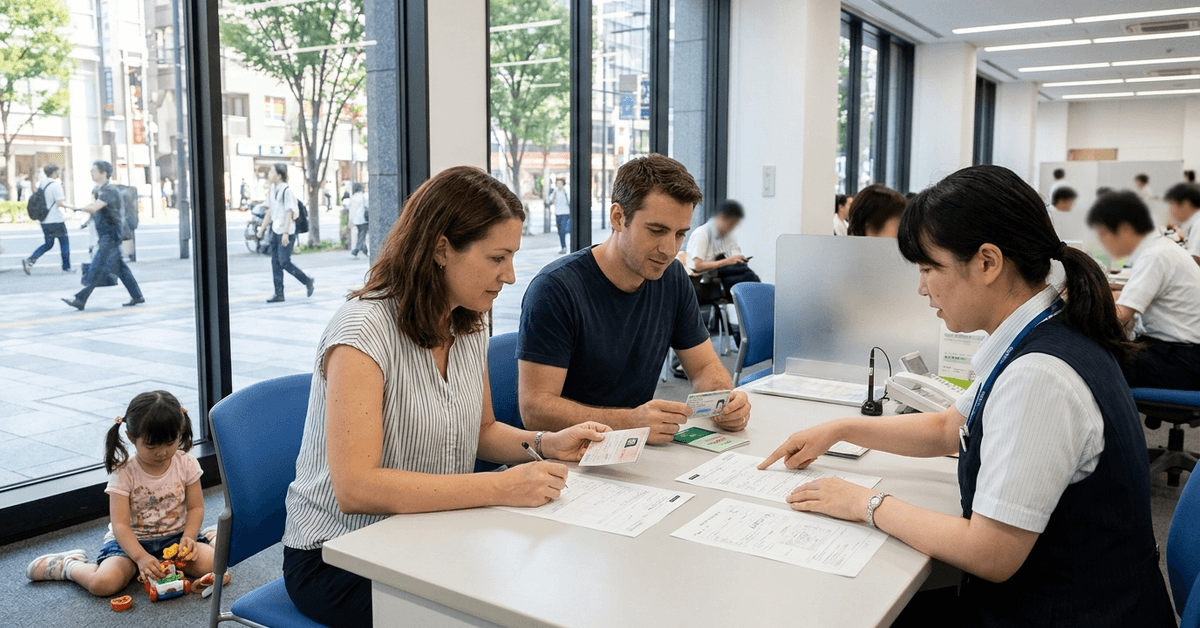
Gather these documents before heading to your local 市区町村役所 (city or ward office):
- Residence card for the applicant (valid status of residence)
- My Number card or notification letter for both parent and child
- Bank passbook or cash card showing account details (must be the applicant's account)
- Birth certificate or family register (koseki touhon if one parent is Japanese)
- Employer documentation, if requested by your specific municipality
The ward office provides the Jidou Teate Nintei Shinsei-sho (認定請求書) application form on site. Some wards have English-speaking staff. Many do not. A translation app or a Japanese-speaking friend can save an hour of confusion.
Who Can Apply: Residency, Not Nationality
Eligibility is decided not by nationality but by whether the applicant has a Japanese resident registration. A common misunderstanding among expat families is that permanent residency or a specific visa type is required. That is wrong.
Two conditions matter:
- The child lives in Japan and has resident registration
- The parent or guardian lives in Japan with a valid residence status and has resident registration
Short-term tourists do not qualify. But a parent on a one-year work visa, a spouse visa, or a long-term resident visa can apply the same day they register at city hall.
One Parent Per Child
Only one parent receives the payment for each child. The recipient of the child allowance is whichever parent or guardian has the higher income.
Dual-income households where both parents earn similar amounts sometimes run into friction at the counter over this rule. Split custody and international divorce cases get complicated fast.
The general principle is that the parent physically living with the child in Japan receives the payment.
But I have seen conflicting advice from different ward offices on this exact point, and the lack of a clean national standard frustrates families in that situation.
The Annual Status Update (Genkyou Todoke) That Stops Payments
Every June, recipients must file a Genkyou Todoke (現況届) to confirm they still qualify. Skip it, and payments pause. Some municipalities send reminders by mail. Others post reminders through online municipal portals. Do not assume a reminder will come.
Moving to a new ward or city requires a fresh application at the new location.
Payment timing is set by national rules but paid by your municipality, and the exact deposit date varies by city or ward. A move without re-registering creates a gap. Over-payments from the old ward can also be clawed back.
The 2026 Child Care Support Fund Deduction
One newer wrinkle for 2026: the Child Care Support Fund introduces salary deductions starting in 2026. The deduction funds the expanded child allowance program.
So while the gross benefit per child increased, a small payroll deduction now partially offsets it for working parents. Check your pay stub for this line item if it has not appeared yet.
Questions People Ask About Japan's Child Allowance (Jidou Teate)
A few common searches that deserve straight answers.
- Q: Can I receive Jidou Teate if I am on a one-year work visa?
Yes. The requirement is resident registration in Japan, not a specific visa type or duration. Register at your ward office and apply on the same visit to stay inside the 15-day window. - Q: Does Jidou Teate count as taxable income?
No. Child allowance payments are not subject to income tax in Japan. They also do not affect your residence tax calculation. The money arrives tax-free into the registered bank account. - Q: What happens to my child allowance if I leave Japan permanently?
Payments stop when you deregister your residence. If the ward office does not process the cancellation immediately, overpayments may be reclaimed. Notify your ward office before departing to avoid repayment notices arriving at an address you no longer occupy.
Conclusion
The Jidou Teate system after 2024's reform is more generous than most expat parents expect, paying up to ¥360,000 per year for a third child.
The 15-day application deadline, the annual June status update, and the new ward registration requirement after moving are the three friction points that cost real money when missed.
A 20-minute trip to city hall the week your child is born or the week you land in Japan is the single highest-return errand on the to-do list. Put it above furniture shopping, above the phone contract, above the bank account if you already have one.