
The monthly Sembrando Vida payment in 2026 is 6,450 pesos. That figure pulls about 445,000 rural participants into a federal agroforestry program that started under López Obrador in 2019 and continues under Claudia Sheinbaum's administration.
But the stipend comes with strings. Participants join a collective work group called a Comunidad de Aprendizaje Campesino (CAC), attend mandatory workshops, plant trees on their land, and submit regular reports. Miss those obligations, and the payments stop.
This article is for the small rural landowner in Mexico sitting on 2.5 or more hectares of underused land, trying to figure out whether signing up is worth the commitment. The answer depends on details that most guides gloss over.
What Sembrando Vida Pays and How the Money Arrives
Participants receive 6,450 pesos monthly, paid after each month of completed work via electronic transfers or payment orders through the Banco del Bienestar.
The payment schedule is published bimestrally. For May-June 2026, the Secretaría del Bienestar confirmed dates during the presidential morning conference on May 4.
The money lands in a Banco del Bienestar account, and recipients can withdraw at their convenience after the deposit date. No intermediaries touch the funds.
The Stipend Compared to Past Years
Back in 2021, the monthly stipend was 5,000 pesos, with 500 pesos automatically directed to savings.
The 2026 figure of 6,450 pesos represents a 29% increase over five years. That sounds decent until you factor in accumulated inflation across that period, which has eaten most of the nominal gain.
Payments Beyond Cash
The program also provides in-kind support: plants, seeds, tools, nursery materials, biofactories, and productive inputs. These extras vary by region and budget availability, so two participants in different states may receive very different packages.
The 2.5-Hectare Rule and Who Sembrando Vida Quietly Excludes
Every eligibility guide repeats the same line: you need at least 2.5 hectares of available land. That part is accurate.
Applicants can use property certificates, or if they lack full ownership, a contract for sharecropping, usufruct, or civil agreement with a minimum four-year validity.
The land needs to be available for agroforestry. Already-forested land does not count. Already-productive commercial land does not count.
Who Qualifies in 2026
The program operates in 24 states, including Chiapas, Veracruz, Oaxaca, Puebla, Guerrero, Tabasco, Yucatán, Michoacán, and Estado de México. Applicants must be 18 or older and live in a rural municipality within one of those states.
Eligible categories include:
- Ejidatarios (communal land holders under Mexico's ejido system)
- Comuneros (members of indigenous communal land structures)
- Pequeños propietarios (small private landowners)
- Jornaleros agrícolas (agricultural day laborers, though the land requirement complicates this)
I think the 2.5-hectare floor creates a blind spot the program rarely acknowledges.
The landless day laborer, the person renting a fraction of a hectare, the widow who inherited less than the minimum: these are often the most economically vulnerable people in rural Mexico, and this program structurally excludes them.
The Ceccam review published in La Jornada in February 2026 made a related point.
The program delivers to individuals only, not to communities or organizations, and requires 2.5 hectares of land possession. That individual-only model breaks from how many indigenous and ejidal communities have traditionally organized agricultural work.
The Deforestation Problem That Follows This Program
This is the part most Sembrando Vida guides skip entirely, and I think it matters more than the stipend amount. A study by Javier Warman, Iván Zúñiga, and Manuel Cervera found that the program caused the loss of approximately 72,830 hectares of forest canopy in 2019 alone.
The mechanism is counterintuitive but simple: the program requires "degraded" or underused land. Some participants cleared existing trees to make their plots eligible.
Bloomberg reported that campesinos enrolled in the program in Yucatán and Campeche admitted to logging and burning trees to receive Sembrando Vida payments.
Seventy percent of the forest losses were concentrated in climate-vulnerable, high-biodiversity municipalities across Chiapas, Tabasco, Yucatán, Quintana Roo, and Campeche.
Can the Government Verify Its Own Reforestation Claims?
According to a Ceccam analysis, the government claims over one million hectares reforested with 1.1 billion trees across six years. But the locations of beneficiary parcels are not public, making it impossible to verify whether those plantations exist or survived.
That 1.1 billion figure would mean roughly 1,100 trees per hectare. Ceccam notes this density is unrealistically high for agroforestry systems that also include milpa and fruit tree intercropping, which require more spacing.
Field observations across multiple regions found far fewer trees per hectare than the official numbers suggest.
How to Register for Sembrando Vida in 2026
The enrollment process is not complicated, but it does require patience and paperwork. The 2026 operating rules were published in the Diario Oficial de la Federación on February 26, 2026.
Registration typically follows these steps:
- Confirm your land meets the 2.5-hectare minimum and gather documentation (property title, usufruct contract, or civil agreement with at least four years of validity)
- Visit the local office of the Secretaría del Bienestar or attend a convened ejidal/communal assembly
- Submit your application with official ID, proof of residence, and land documentation
- Complete a field verification visit (staff have 20 days to conduct it)
- Wait for acceptance notification and assignment to a CAC group
Program staff have up to 20 days to complete verification visits. If the visit does not happen in that window, the application is discarded. That deadline matters. Follow up if nobody contacts you.
Mistakes That Cost Applicants Their Spot
A few common errors trip up applicants. Land documentation is the biggest one. A verbal agreement to use someone else's land is not enough. The contract must be written, signed, and carry a minimum four-year term.
Applying from a state where the program does not currently operate is another dead end. Check the Sembrando Vida official portal for the current list of participating states before starting paperwork.
Life Inside a CAC: What the Commitment Looks Like Week to Week
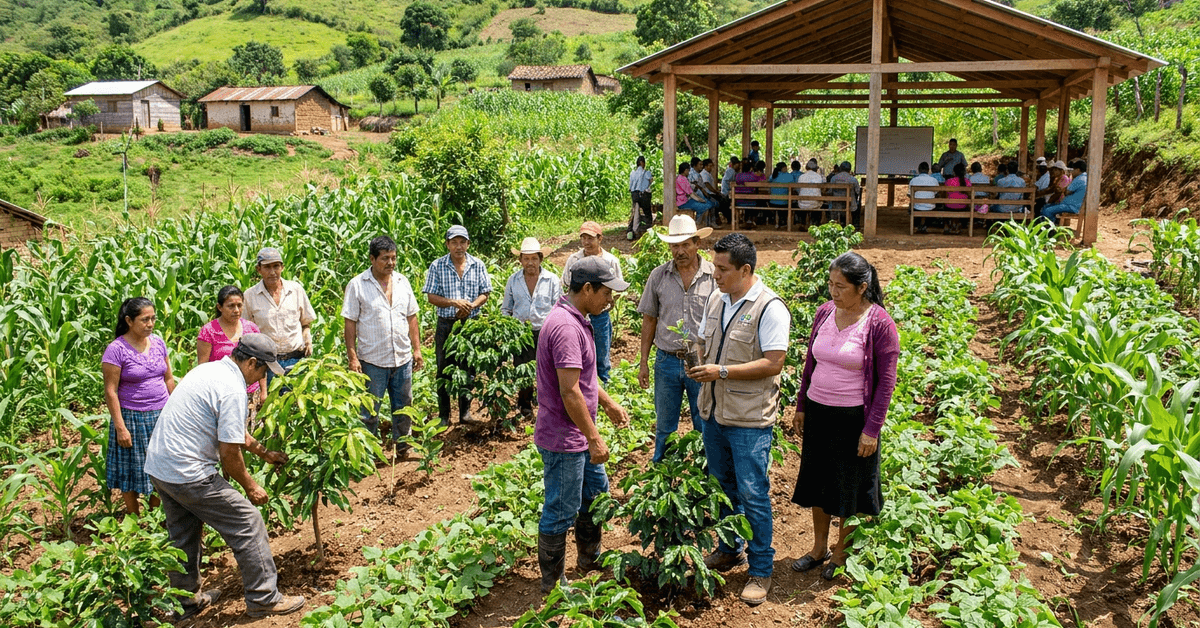
Once accepted, participants join a Comunidad de Aprendizaje Campesino. These groups meet regularly and work collectively on agroforestry plans for their assigned areas.
The program assigns technical advisors to each CAC. These advisors run workshops on soil management, pest control, seed selection, and sustainable farming techniques. Attendance is mandatory.
When Participants Lose Access
The commitment is not casual. Skipping group meetings, failing to maintain your assigned plot, or not filing progress reports can result in removal from the program and loss of payments.
Some participants find the bureaucratic reporting load frustrating, especially those accustomed to managing their land independently.
Making the CAC Work in Practice
Participants who get the most out of the program tend to do a few things consistently:
- Keep written records of planting schedules, workshop attendance, and any setbacks on their plot
- Build relationships within the CAC group early, since collective decisions affect individual parcels
- Ask technical advisors specific questions rather than waiting for general workshops to cover relevant topics
Questions People Ask About Sembrando Vida
These are the questions that come up most often beyond the basics covered above.
- Q: Can I receive Sembrando Vida and another government subsidy at the same time?
Receiving multiple direct federal subsidies is generally restricted, but some municipal or state-level agricultural programs can run alongside Sembrando Vida without penalty. Check current rules through the Secretaría del Bienestar, since these restrictions change between fiscal years. - Q: How long does Sembrando Vida last for each participant?
There is no fixed graduation date published in the 2026 rules. Participants remain enrolled as long as they meet obligations and the program continues receiving federal budget allocation. That open-ended structure can feel uncertain, since funding decisions happen annually. - Q: Do I need to own the land outright to qualify?
No. Ejidatarios, comuneros, and people with usufruct or sharecropping contracts qualify, as long as the agreement is documented and covers at least four years. Verbal arrangements do not count.
Conclusion
Sembrando Vida puts 6,450 pesos monthly into the hands of rural landholders willing to commit to agroforestry. The program's deforestation controversy deserves serious attention from anyone evaluating its environmental claims.
Eligibility hinges on land access, geographic location, and a willingness to work collectively through a CAC. The stipend helps, but the real question is whether the obligations and trade-offs fit your specific situation.