A single adult in Tokyo can receive roughly 130,000 yen per month through Seikatsu Hogo, Japan's livelihood protection program. That breaks down to about 77,000 yen for living expenses and up to 53,700 yen for housing.
Most English-language guides treat this program as a citizens-only benefit with a vague footnote about exceptions. That framing misses the roughly 932,000 permanent residents living in Japan as of mid-2025, many of whom qualify under the same rules as Japanese nationals.
This article is for foreign nationals on permanent or long-term residence visas who hit a financial wall and need to know exactly how the seikatsu hogo application works, what it pays, and where the real friction sits.
Do Foreign Residents Qualify for Seikatsu Hogo?
The short answer: yes, in practice, if the visa status is right. The longer answer involves a 2014 Supreme Court ruling that still confuses people seven decades after the Public Assistance Law was enacted in 1950.
The 2014 Supreme Court Ruling and What It Changed
Japan's Supreme Court ruled in 2014 that foreign nationals do not have a legal "right" to seikatsu hogo under the Constitution. That sounds like a disqualifier. It isn't.
The ruling did not stop local governments from providing benefits.
The decision was limited to tax-funded poverty relief and does not necessarily change current practice, since foreigners with permanent residence status are typically granted public assistance.
The plaintiff in that case was eventually approved on her second application.
Which Visa Statuses Can Apply
Not every visa holder is eligible. The Ministry of Health, Labour and Welfare issues administrative guidance that extends seikatsu hogo coverage to specific residence statuses:
- Permanent residents (eijuusha)
- Spouses or children of Japanese nationals (nihonjin no haiguusha)
- Long-term residents (teijuusha) with settled status
- Special permanent residents (tokubetsu eijuusha), primarily Zainichi Korean and Chinese residents
I would skip applying on a standard work visa or student visa. The welfare office will almost certainly reject it. The line is drawn at statuses that signal long-term ties to Japan.
How Much Does Seikatsu Hogo Pay?
The program does not write a flat check. It calculates a minimum cost of living based on location, age, and household size, then fills the gap between that floor and the household's actual income.
A Tokyo Single Person vs. a Family of Four
A single adult in Tokyo typically receives around 77,000 yen per month for living expenses plus up to 53,700 yen for housing, totaling roughly 130,700 yen. A family of four in Tokyo can receive approximately 269,790 yen per month.
| Category | Single Adult (Tokyo) | Family of 4 (Tokyo) |
|---|---|---|
| Living expenses | ~77,000 yen | ~200,000 yen |
| Housing subsidy | Up to 53,700 yen | Up to 69,800 yen |
| Medical care | Covered separately | Covered separately |
| Education costs | N/A | School supplies covered |
The medical assistance component is separate and paid directly to providers. Recipients do not handle those payments.
Smaller cities fall under lower area classifications. A single person in a Grade 3 area might receive 30% less than the Tokyo figures above. The cost-of-living calculation adjusts downward to match local prices.
The Eight Categories of Assistance
The program splits support into distinct types, each covering a different expense:
- Living assistance (seikatsu fujo): food, clothing, utilities
- Housing assistance (juutaku fujo): rent subsidies up to a cap
- Medical assistance (iryo fujo): treatment costs paid to providers
- Education assistance (kyouiku fujo): school supplies and fees for children
- Nursing care assistance (kaigo fujo): home modifications, care services
- Childbirth assistance (shussan fujo): delivery-related costs up to 336,000 yen
- Vocational assistance (seigyou fujo): job training costs up to 92,000 yen
- Funeral assistance (sousai fujo): up to 222,000 yen for adults
Not every recipient gets all eight. The caseworker builds a package based on the household's specific situation.
The Application Process at the Welfare Office
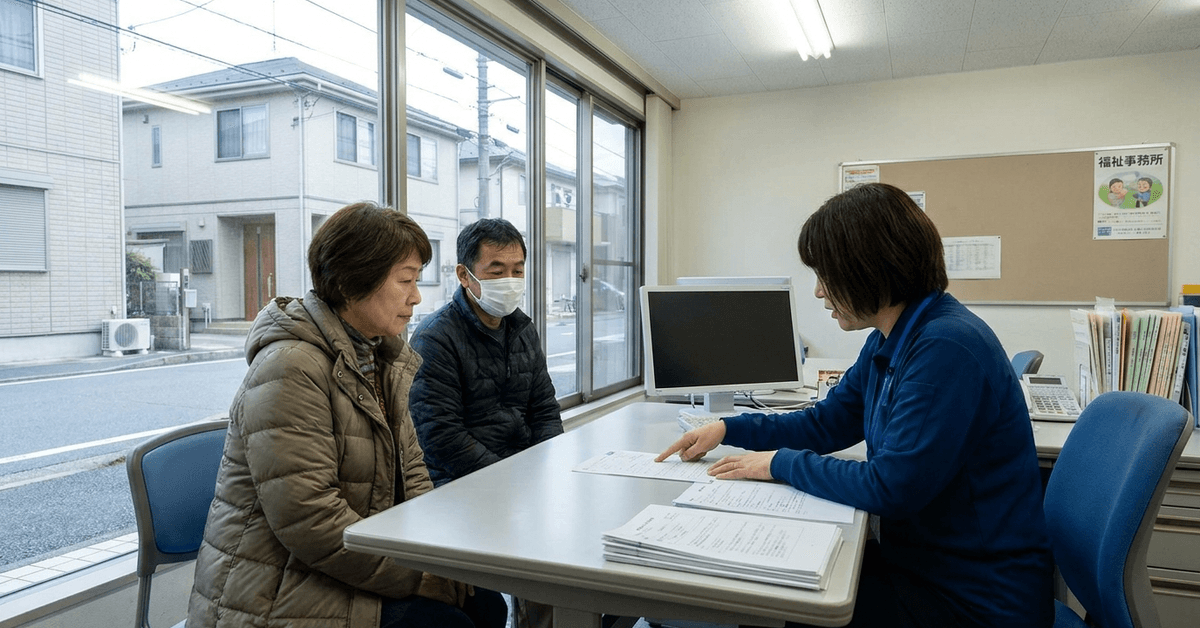
Walking into a fukushi jimusho (welfare office) for the first time feels like entering a government building designed to test patience. No appointment is needed. But the experience can feel overwhelming, especially for non-Japanese speakers.
Step One: The Consultation Window
The first visit is a consultation, not yet a formal application. A caseworker reviews the situation: income, assets, employment history, household composition. Expect direct questions about savings accounts, insurance policies, and family members who might provide financial support.
I think this consultation step is where most foreign applicants lose momentum, specifically because some welfare offices use it to discourage applications before they're formally filed.
If a caseworker suggests "trying harder" or "coming back later," the correct response is: "I want to formally submit an application." Once those words are spoken, the office is legally required to accept the paperwork.
Step Two: Document Submission
The office requests specific documents after the consultation. A standard list includes:
- Residence card (zairyu kaado) and My Number card
- Bank statements and proof of savings
- Pay stubs or a letter explaining unemployment
- Rental contract and recent utility bills
- Health insurance card (if applicable)
Missing documents are the most common reason for delays. Gather everything before the first visit. Make copies.
Step Three: The Investigation Period
After the application is filed, the welfare office verifies every claim. Staff may visit the applicant's home for investigation and check whether submitted documents match actual living conditions. They contact banks, landlords, and sometimes employers.
This phase typically takes two to three weeks. Cases with missing paperwork or complicated household situations can take longer.
Step Four: The Decision
A written notification arrives by mail. Approved cases receive benefits retroactive to the date of the initial application visit. Denied cases get a written explanation, though these tend to be technical and hard to parse without help.
Applicants have the right to appeal a denial through the formal objection process (shinsa seikyuu) within three months.
Can Seikatsu Hogo Recipients Keep Working?
Yes. The program does not require unemployment. Earnings reduce the benefit amount yen-for-yen against the minimum living standard, but partial support continues as long as income stays below the threshold.
A person earning 60,000 yen per month in a city where the minimum standard is 130,000 yen would receive roughly 70,000 yen in seikatsu hogo. The math adjusts as income changes.
I would push back on the widespread advice to "exhaust all other options before applying." That framing keeps people in financial crisis longer than necessary. The program explicitly covers working people whose income falls short.
Waiting until savings hit zero means weeks of hardship that the system was designed to prevent.
The Asset Question: Cars, Savings, and Property
Welfare offices expect applicants to use existing assets before receiving public funds. But "use" does not always mean "sell."
A car needed for commuting to work in a rural area, or required for medical transport due to disability, may be exempt.
A second home or investment portfolio will not be. Savings above a small threshold (often around 50,000 yen for a single person, though this varies) must be spent down first.
The practical test: does the asset have a use that supports daily life or employment? If yes, exemption is possible. If it sits as stored wealth, the office will expect it to be liquidated.
Does Receiving Welfare Affect Immigration Status?
This question stops many foreign residents from applying. Japan's ruling LDP has been considering adding Japanese language proficiency as a requirement for permanent residency, and immigration screening has become noticeably stricter since late 2025.
Receiving seikatsu hogo does not automatically trigger visa revocation. But the program's records can surface during future immigration proceedings: permanent residency renewals, naturalization applications, or status changes.
The safest move is to consult both the welfare office and an immigration lawyer when these two systems might intersect. Legal aid organizations like Houterasu (Japan Legal Support Center) offer free consultations for low-income residents, including foreigners.
Alternatives When Seikatsu Hogo Doesn't Fit
The program has strict criteria. Some residents fall just above the income threshold or hold visa statuses that don't qualify. Several other programs fill gaps:
- Juukyo kakuho kyuufukin (Housing Security Benefits): rent subsidies for people who lost employment or face equivalent hardship, paid directly to landlords for up to nine months
- Jidou teate (Child Allowance): monthly payments for families with children, regardless of income level
- Emergency small loans (kinkyuu kogaku shikin): interest-free loans from social welfare councils for temporary needs
- Municipal fee reductions: many cities reduce national health insurance premiums and medical copays for low-income residents
Local social welfare councils (shakai fukushi kyougikai) and NPOs like SHARE can help foreign residents piece together the right combination. Trial and error is normal. The first program tried is rarely the last.
Questions People Ask About Seikatsu Hogo
These are the questions that come up most often for foreign residents considering the program.
- Q: Can a welfare office refuse to accept my application?
No. Once an applicant states they want to formally apply, the office must accept the paperwork. The consultation stage is separate from the application. Knowing the difference between a consultation and a formal application changes the entire dynamic of that first visit. - Q: How long can I receive seikatsu hogo benefits?
There is no fixed time limit. Benefits continue as long as income stays below the minimum living standard. Caseworkers conduct periodic reviews, usually every few months, to check whether circumstances have changed. The program encourages a return to financial independence, but does not cut people off arbitrarily. - Q: Will my family overseas be contacted?
The welfare office may ask whether family members can provide financial support. For foreign applicants, this typically means family in Japan, not overseas relatives. The office lacks practical means to verify overseas family finances, though they may ask about remittances.
Conclusion
Seikatsu hogo exists because financial crises do not respect nationality or visa category. The program is procedural, slow, and sometimes frustrating in its paperwork demands.
Foreign residents with permanent or long-term status have access to the same benefits as Japanese citizens in practice.
The welfare office door is open to anyone whose income falls below the minimum standard, and knowing how to walk through it makes the difference between months of struggle and a structured path back to stability.